Grade 10
Choosing your IB Diploma subjects

In this section you can:
- Learn about testing from the experts.
- Learn more about the IB Diploma.
- Explore our Subject by Subject guide.
- Get answers to your frequently asked questions.
- Take concrete action now with these ideas.
- Tell us what you’re on your mind…
Expert View – what the old guys think!
Find out everything that is important to know IB subject selection from our resident expert.
Important Links
More information on the IBDP can be found on the IB website
Introduction to IB Diploma

The IB diploma is a rigorous academic program with world-wide recognition; it prepares you to enter universities around the world.
Students can earn an IB Diploma by achieving points for each course gained through a combination of internal coursework and rigorous examinations at the end of Grade 12.
For course selection, students choose 3 higher level subjects and 3 standard level subjects, in addition to completing the three elements of the IB Core: Theory of Knowledge, Extended Essay and Creativity, Activity and Service.
The IB Diploma Programme is designed to give students a balance of depth and breadth in subject material, and to prepare them to study at university level and beyond.
Learn more about the IB Diploma
Explore the structure of the IB Diploma
The structure of the IB Diploma
Subject Groups
Students following the IB Diploma take six subjects, 3 at Higher Level and 3 at Standard Level.
One subject is chosen from each of the six Groups below;
- Group 1 – Language A (studies in Language and Literature)
- Group 2 – Language B (Language Acquisition)*
- Group 3 – Individuals and Societies
- Group 4 – Sciences
- Group 5 – Mathematics
- Group 6 – The Arts**
*A second subject from Group 1 may be taken instead.
**A second subject from Group 3-4 may be taken instead.
Course Descriptions
- Group 1: Studies in Language and Literature
- Group 2: Language Acquisition Second Language
- Group 3: Individuals and Societies
- Group 4: Sciences
- Group 5: Mathematics
- Group 6: The Arts
The IB Core Subjects:
- Theory of Knowledge: Theory of Knowledge
- Extended Essay: Extended Essay
- Creativity, Activity and Service: Creativity Activity and Service
The Theory of Knowledge (TOK) course is designed to develop critical thinking and a coherent approach to learning, and transcends and unifies the academic areas, providing an opportunity for students to reflect on the nature of knowledge, and on how we know what we claim to know.
The Extended Essay is a research report of up to 4000 words that offers the opportunity to investigate a topic of special interest and prepares students with independent research and writing skills that will stand them in good stead at university.
The Creativity, Activity, and Service (CAS) program encourages students to be involved in sports, artistic pursuits and community service work.
The IB make no further specific restrictions on course combinations other than those listed above; students may choose any combination of subjects at HL or SL as long as the above requirements are satisfied.
Some official IB Diploma information
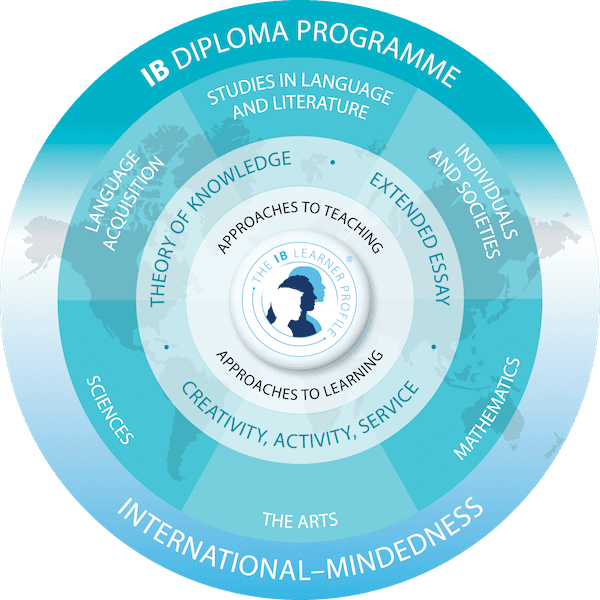
The IB Diploma Program model
(Click to enlarge)
How the IB assesses the Diploma
Find out about DP assessment
Students are scored on a scale of 1–7 points from results of examinations and coursework.
Subjects are graded according to the following scale.
- 7 Excellent
- 6 Very good
- 5 Good
- 4 Satisfactory
- 3 Mediocre
- 2 Poor
- 1 Very poor
- N No grade
The TOK course and the Extended Essay are graded according to the following scale.
- A Excellent
- B Good
- C Satisfactory
- D Mediocre
- E Elementary
- N No grade
To be awarded an IB Diploma, students must satisfy the following requirements:
- Total Points - The candidate has gained 24 total points or more across all subjects, including bonus points.
- HL Points – The candidate has gained 12 points or more on HL subjects (for candidates who register for four HL subjects, the three highest grades count).
- SL Points – The candidate has gained 9 points or more on SL subjects (candidates who register for two SL subjects must gain at least 5 points at SL).
- Grade of 3 – There are no more than three grade 3s or below awarded (HL or SL).
- Grade of 2 - There are no more than two grade 2s awarded (HL or SL).
- Grade of 1 – There is no grade 1 awarded in a subject/level.
- Grade of “N” – There is no “N” awarded for TOK, the EE or for a contributing subject.
- Grade of “E” – There is no grade E awarded for TOK and/or the EE.
CAS – Creativity, Activity, Service requirements have been met.
Action ideas
Things you can do that will make a big difference.
Action 1:
Check on the university website to see what IB subjects they require for your chosen course
action 3:
Talk to your teachers and find out what the course content is in each IB diploma subject
action 6:
Seek advice from your IB diploma coordinator and your college counselor
ACTIOn 2:
Keep your options open, especially if you’re not sure what you want to study at university
action 4:
Make a list of subjects that you are good at and enjoy
I want to study…
Which IB Diploma courses should I take?
Engineering
Medicine
Computing
Business /Economics
Sciences
Social Sciences
Arts
Visual Arts
Languages
Some critical questions that need to be asked
Sometime the questions are more important than the answers.
question 1:
Have you looked at the university websites to see what subjects they require?
question 3:
Should you select a higher level subject even if you are currently struggling in that subject?
question 2:
Which higher level subjects should you select?
question 4:
Is it best to study subjects that you’re good at and enjoy?
Country for country university requirements
Just some thoughts!
- Overall IB diploma recognition in a specific country.
- University requirements for specific subjects and courses.
Some universities will make requirements for specific HL courses to be taken in order to gain entry to certain programs of study.
More information can be found on individual university websites or at the IB’s recognition website.
Examples:
United Kingdom – UK universities will generally require the IB Diploma, with specific courses and course results at Higher Level. These requirements vary by university and course of study, and students are encouraged to research these. Some UK universities will accept students with a High School Diploma alone, particularly for Foundation Courses.
United States – US universities will generally require only the High School Diploma + SAT/ACT scores, although an IB Diploma may be considered a bonus for admissions committees. Top US universities will require either AP Subjects or the IB Diploma.
Canada – Canadian national universities will generally require the IB Diploma, although some may accept students with the High School Diploma + SAT scores. Canadian universities will generally require Maths Analysis (SL or HL) or Maths Applications (HL) for courses with Mathematics as a prerequisite.
Netherlands – Dutch national universities will require the IB Diploma, although a few Hogescholen (Universities of Applied Sciences) accept the High School Diploma alone. Some Dutch universities will not recognize maths applications standard level for entry to certain subjects.
Getting support
Are you confused? Not sure who to turn to for advice? Don’t worry, every school has people who are waiting to help you, wanting to help you and willing to help you.
The IB Diploma Coordinator
The IB Diploma Coordinator will provide you with the information about the subjects available in your school. He/she will help you put your program together.
Teachers
Teachers are a great source of information about what you will be studying in each subject during grades 11 and 12. The teachers already know you, so they can give you some indication as to whether they consider you to be suitable to study their subject at higher level or standard level.
College Counselors
It’s always a good idea to speak to your counselor and discuss how your selection of IB diploma subjects will impact what you can potentially study at university.
Students
Go and talk to the grade 11 and 12 students in your school, this way you can find out what it’s like to be an IB diploma student and what it’s like to study a particular subject. They can give you tips – particularly in the area of time management.
Wigsbury Frequently asked questions
Quick answers to lost of the important questions
How many subjects can I take?
For a full IB diploma, you must take three higher level subjects, three standard level subjects and successfully complete Theory of Knowledge, CAS and the Extended Essay.
When do I have to choose my IB diploma subjects?
Most schools require you to select your IB diploma subjects while you are still in grade 10. (Schools need time to plan the curriculum and make a timetable so everyone is ready to start at the beginning of grade 11).
Can I take any subject I choose?
You will need to select one subject from each of the six subject areas. Your school will provide you with a list of which subjects they offer.
Can I go to university with the IB diploma?
Yes. The IB diploma is recognized worldwide, although some countries may impose specific requirements with regard to subject level and selection.
How can I find out which subjects my school is offering?
Ask your IB Diploma Coordinator.
Do schools have to offer IB diploma subjects at both higher and standard level?
Some schools may only offer a particular subject at standard level and not at higher level. Ask your IB diploma coordinator.
How can I find out which subjects would be best for me?
It is best to take subjects that you are interested in, enjoy and in most cases opt for higher level subjects that you are good at. It is always a good idea to talk to your teachers, your IB Diploma Coordinator and your College Counselor.
Do I have to take certain IB subjects to prepare to study a particular subject at university?
This depends on what university subject you want to take. Some subjects at university have very specific requirements. E.g. If you want to study medicine you will need to take higher-level chemistry and biology. Other university subjects are more flexible. The best way to find out is to go and look on the university websites.
Is the IB diploma hard work?
Yes. If you are going to achieve success in the IB diploma, you will need to work hard and particularly manage your time effectively. Don’t procrastinate!
Can I still go to university without an IB diploma?
Yes. Some countries do not require an IB diploma e.g. USA. You can enter with a high school diploma plus SAT/ACT scores. In other countries you may be able to access some university courses without a full IB diploma. The picture is very mixed and the best advice is to go and look on the university websites at their admissions requirements. As a tip, many universities offer foundation degree courses and these do not normally require a full IB diploma.
I want to study engineering at university, do I need to take higher level maths and physics?
Yes. Most engineering degrees will require higher level maths and higher level physics, however there are some universities which will take you with standard level. There are also foundation degrees in engineering which have easier admissions requirements.
I want to take higher level maths, but I’m not sure whether I’m good enough. What can I do?
Talk to your maths teacher, and also have a look at the past exam papers.
I want to study my native language in the IB but my school does not offer it as a subject. Is it still possible to study my native language privately?
Yes. Talk to your IB diploma coordinator and find out what your school’s provision is for self-taught courses.
I want to take my native language as a language B in the IB diploma, and I want to take the exam at the end of grade 11. Is this possible?
Yes, unless your school has a policy that does not permit this. The advantage for you as a student in taking a language at the end of grade 11 is that it frees up time during grade 12 which is when you will be busy working on not only your IB diploma program, but also your university and college applications.
I want to study three science subjects, but the IB only offers me the chance to study two science subjects. Is there a way around this problem?
It is very unusual to take three science subjects. Your IB Diploma Coordinator would have to seek approval from the IB.
I have no idea what I want to study at university and I am having a hard time selecting my IB subjects. Where can I get good advice?
Talk to your teachers, your IB Diploma Coordinator and your College Counselor.
I am a student in a small school with a limited number of IB subjects on offer. Can I study subjects that I’m not offered in school?
Yes. There are online offerings for many different subjects. One of the best-known providers is Pamoja Education . Talk to your IB diploma coordinator.
I am a top student in all subject areas in grade 10. I could easily study all of these subjects at IB higher level. How should I decide which 3 subjects to study at higher level, and which 3 to study at standard level.
Good question! You’ll need to set yourself some priorities: the first and most obvious one is do you need specific higher level subjects in order to study your chosen subject at university? If the answer to this question is no, and you’re heading to university to study something that does not have any specific entry requirements, then I would recommend that you select three high-level subjects that you enjoy the most, and that interest you.
I would like to take four IB higher-level subjects. Is this possible?
Some schools permit this, although be aware that this is going to be a very heavy workload for you. Ask yourself if it’s really necessary to study 4 higher-level subjects. What benefit would you get from moving one of your standard level subjects up to higher level? You also need to talk to your IB Diploma Coordinator as some schools do not permit this. Also consider that there may be timetabling/ scheduling problems.
How many times a year are IB diploma exams offered?
IB exams are offered in November and May each academic year.
Supposing I fail my IB diploma, can I re-sit my exams?
Yes. You can re-sit individual subjects.
I know what I want to study at university and I want to make sure I select the right subjects in the IB diploma to enable me to apply to university. How can I find out which IB subjects to select?
The easiest way is to go onto the university websites and check their entry requirements, that way you can see which subjects you need to study in the IB diploma. But remember, just because one university wants higher level maths, another may only require standard level maths.
My school has given me a list of subjects available in the IB diploma but I’m not sure exactly what I would have to study in each subject/what the course content is. How can I find more information about the subject content?
There are two quick and easy ways to do this: firstly, go onto the IB website and look at the curriculum content for each subjects. Secondly, go and talk to the subject teachers in your school.
Supposing I select the subject and then after a few weeks of grade 11 I realise it was the wrong choice for me. What can I do? Can I change subject?
Each school has its own policy on this so you’ll need to talk to your IB Diploma Coordinator. However, there are a couple of things you need to keep in mind if you are thinking of changing. If you want to drop one of your higher level subjects down to standard level, you will then have to raise one of your standard level subjects up to higher level in order to maintain the 3 and 3 balance. If you want to drop a subject altogether and start with a new subject, the longer you leave it the more work you will have to catch up.
I have read the information my school has given me, but how can I find out what it is really like to be in IB diploma student?
Talk to the students in grade 11 and 12.
I have heard from the senior students in my school that the IB diploma is a lot of work. I am worried about how I will manage this. Where can I get help and advice on managing the workload?
Your IB Diploma Coordinator will have tips on how to manage the workload and help you create a timeline. If you are struggling in a particular subject then you should go and talk to your subject teacher. But it is important to seek help, the longer you leave it the bigger the problem will become.
I am worried about writing the IB extended essay. It looks like a really big project and I have no idea where to start. What can I do?
Each student is allocated an extended essay supervisor. He/she can certainly help you with this.
I like the idea of the CAS program. I do dog walking for my neighbour, can I do this for CAS.
Yes. Go and talk to your CAS Supervisor, he/she will have lots of ideas and a list of activities for you.
I know for sure that I’m going to study in the United States. Do I need to do the full IB diploma.
No, however if you want to go to a top university they will want to see evidence that you have selected the most rigourous academic program offered in your school… and this means the full IB diploma… plus you’ll need SAT/ACT for many universities. If, however, you’re not heading to a top university, then you can certainly go with just a high school diploma + SAT/ACT. The bottom line is the IB diploma offers you access to top universities, and a wider choice of universities.
I have heard that students who do not do the full IB diploma can do something called IB certificates. What is this?
You can just take individual subjects/ classes, and you’ll get a certificate from the IB stating which subjects you took and what grade you achieved. In many schools this will form the basis for your High School Diploma. You need to talk to your IB Diploma Coordinator to find out what your school is offering.
Not all students in my school take the IB diploma, some do a high school diploma. What is the difference between these two and which one would be right for me?
The answer to this question depends on two main factors: firstly, do you need a full IB diploma to get into your university of choice? Secondly, is studying the full IB diploma too demanding for you? You will need to have a conversation with your IB Diploma Coordinator and also with your College Counselor to find out what the options are both in terms of your high school academic program and the impact on your university applications that leaving the IB diploma program and going onto a high school diploma would entail.
Will my teachers help me decide whether I can take their subject in the IB diploma?
In many schools the teachers of the grade 10 students make recommendations. Is the student capable of studying the subject at higher level, standard level or not at all.
I love languages. How many can I study in the IB diploma?
This will depend on the scheduling within your school. Ask your IB Diploma Coordinator
I want to study business at university. Which IB diploma subjects do I need to choose?
You’re in a good position, most university business courses don’t make any subject specific demands for entry. Obviously if you want to go to a top university, you’ll need to have top grades. If however, you want to take a business program that focuses on areas which are maths intensive such as accountancy, finance etc. Then you may have to take maths higher level. It’s best to check the university websites, this will give you a clearer picture of what’s required and thus help you select your IB diploma subjects.
I want to study engineering at university. Which IB diploma subjects do I need to choose?
Higher level maths and physics are recommended, although some universities will accept standard level. Beware, most require high-level. There are also foundation engineering programs that you can enter without higher level maths and physics.
I want to study psychology at university but my school doesn’t offer psychology as an IB diploma subject. Does this mean I can’t study psychology at university?
No problem. Universities know that not all schools offer psychology as a subject, so therefore universities do not demand this.
I want to study art in group 6, but my parents want me to take a second science subject instead. What can I do?
This is a tough situation for you. It depends on what your parents want you to study university. If they have a particular science based course in mind, then I suggest you have a look for this course but one that combines with something creative thus allowing you to say to your parents that the university values students who have taken art at IB diploma level.
I have only been studying English for four years and all my friends have been doing English since grade 1. I am worried about how I will cope with the English exam in the IB diploma.
Don’t worry, there are multiple levels of English courses and there is certainly one that will fit your needs, most likely English B either standard or higher level. But you should talk to your English teacher and ask for his/her advice.
Tell us what’s on your mind!
If you have something that you want to share…
1 Comment
Submit a Comment
You must be logged in to post a comment.
We’re excited to hear what you have to say!
Please note that all comments are looked at by our team before they are posted in this section. As a result, there may be a delay between you posting and it appearing here.